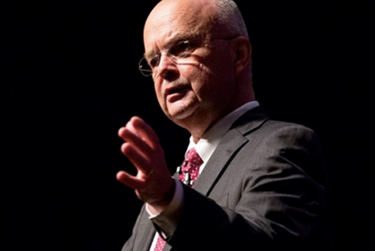
General Michael Hayden is something of a visionary when it comes to discussing the Internet. Hayden’s public image has largely been shaped by his role as a hard-nosed, four star General running two of the largest security agencies in the United States (the National Security Agency and the Central Intelligence Agency). During this time, he received the most media attention for his views on surveillance, with the Snowden revelations pitting him against a group of whistleblowers in a battle positioned as state versus liberty.
However, it only takes a few minutes with Hayden to realize his views on digital culture are much less one-dimensional. Hayden has an important message about the impact the Internet is going to have on our businesses, our politics and our world: there are no longer any distinctions between geopolitics and private business.
The Internet, says Hayden, is like the first wave of globalization – The Age of Discovery. “Like the Age of Discovery, the Internet brings many positive elements such as trade. However, the Age of Discovery also had dark sides that weren’t initially imagined – it also gave birth to the rise of the slave trade. As obsessed as we are with cyber things, I still think we underestimate its impact on people’s lives and our future.”
Hayden envisions the Internet as attempting to imagine a horizon that cannot yet be seen, but the consequences of it will rapidly transform our world. The Internet is “like the Wild West”, with all sorts of state and non-state actors capitalizing on its potential. It is a world where unprecedented trade is possible, but the very network it is founded on also makes it vulnerable.
Appointed as Director of the NSA just four years after Tim Berners-Lee established his first Worldwide Web CERN node, Hayden’s career mirrors the explosion of the Internet into our daily lives. Hayden’s life has been dedicated to not only reacting to the digital environment, but also future-casting its pitfalls, so when he raises alarm about the conflation between business and geopolitics, he is certainly worth listening to. After all, how many others have been in the unique position to view such privileged information on how conflicts unfold?
Hayden argues the new cyber environment is one where the boundaries between individual business, state and globe are much more fluid. Companies have become supranational, operating on budgets the size of the GDP of nations. Companies, in contributing large sectors of the stability of economies, are vulnerable to attack from actors with political motivations, as attacking the company ricochets on the state. Unlike traditional warfare, which is expensive and politically unpopular, cyber warfare is cheap and easily denied. State and corporate secrets can be stolen, communications monitored, business disrupted, and propaganda distributed. Companies, both large and small, will play a central role in shaping our economic security and success.
“Again this is a parallel to the Age of Discovery”, Hayden surmises. “We have private companies that have taken on the attributes of nation states and acting as sovereign entities – East India Tea Company, Hudson Bay, and so on. And today, we have come to the mirror image of that, with Google and Microsoft. And these companies become supranational institutions. And now you’ve got those companies going head to head with governments about privacy and subpoenas, and unbreakable encryptions. And at that level, there are no distinctions between geopolitics and private business.”
“Now, on the level of smaller businesses, you have a few things that you keep in a safe or a desk drawer, but they’re in this new domain where they are subject to all sorts of evil doers. There are as yet no international norms in that building. For business to participate in the development of those international norms, because they have more at stake in that domain than governments do.”
WHO
General Michael Hayden has played a crucial role in shaping US policy towards cyber as former Director of the National Security Agency from 1995-2003, Principal Deputy Director of the Central Intelligence Agency from 2003-2005, and Director of the CIA from 2005-2008. He is currently on the Board of the Atlantic Council, and serves as a Professor at Georgetown University.
WHERE
The Center for Strategic Cyberspace + Security Science spoke to him about the overlap between cyber geopolitics and business in the lead up to his keynote presentation at our Washington Geopolitical Summit (May 4-5, 2015).
WHY
At the Washington Geopolitical Summit, he will be offering his concrete perspectives on cyber security, the contemporary global business environment, and governance.
WHAT
For more information on our organization, see www.cscss.org. For our Washington Geopolitical Cyber Intelligence Summit, see www.cscss.org/cventdc.